Time Lapse View from Space
This incredibly beautiful night time lapse footage was shot with high-definition cameras aboard the International Space Station. View full screen for best effect.
This incredibly beautiful night time lapse footage was shot with high-definition cameras aboard the International Space Station. View full screen for best effect.
This is really beautiful. A piece of red fabric floats and dances in a vortex of wind created by a circle of fans. The longer you watch it, the more it seems to be moving on its own, like a dancer.
In the spirit of the slow-motion exploding lighter in a blender, here's a video of a match lighting at 2000 frames per second. It takes 2 1/2 minutes to finish lighting!
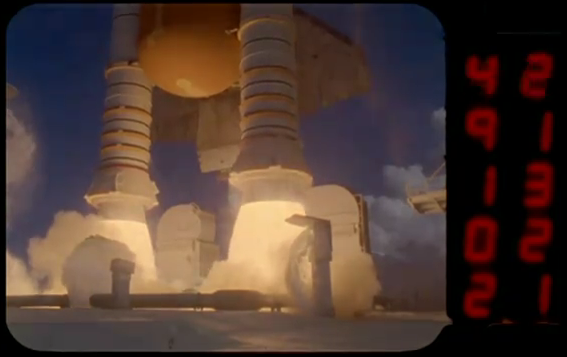
NASA has released this 45-minute compilation of space shuttle launches filmed at up to 400 frames per second from various angles. You can see plumes of hydrogen gas billow and ignite, explosive bolts releasing boosters from the platform, and chunks of ice tumbling slowly. [YouTube]
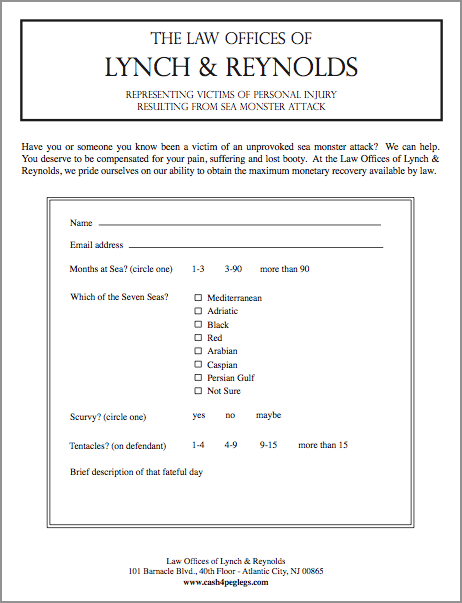
At the Law Offices of Lynch & Reynolds, we specialize in representing the victims of personal injury resulting from sea monster attack. At a recent symposium for sea monster experts in San Francisco, we handed out a questionnaire to potential clients. We present here the data we gathered, as well as the harrowing tales of nautical woe from the victims themselves.
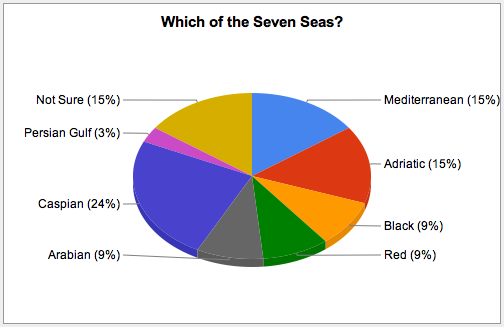
Clearly the Caspian sea, with 24% of all attacks, is the most sea-monster-saturated of all the seven seas, followed by the Mediterranean and Adriatic. 15% of victims appear to have been sufficiently disoriented by their traumatic experiences that they can't even remember which sea they were in at the time. The Persian Gulf appears by far to be the safest of all the seas with regard to the risk of sea monster attack.
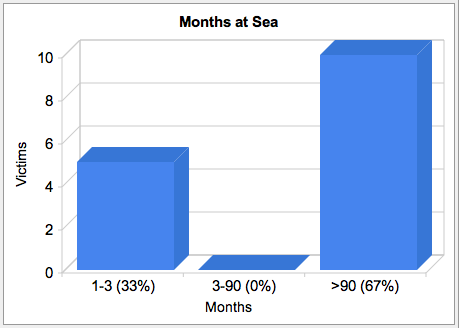
Sea-monster-attack victims are a salty lot, judging by the fact that 67% of them had been at sea more than 90 months before being attacked.
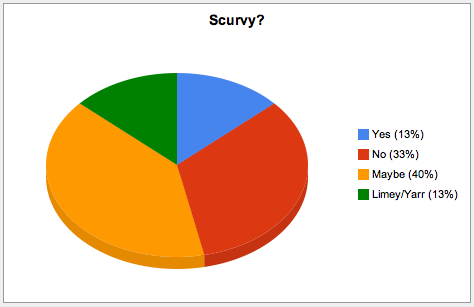
And these sailors appear to have brought plenty of Sunny-D with them, as scurvy rates were quite low.
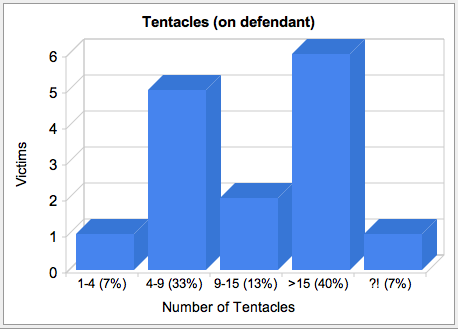
Over 40% of attacking sea monsters have more than 15 tentacles. From this we can conclude that they are really, really scary. This undoubtedly contributes to the undue mental anguish our clients endure.
And here we present the collected stories of the surveyed victims.
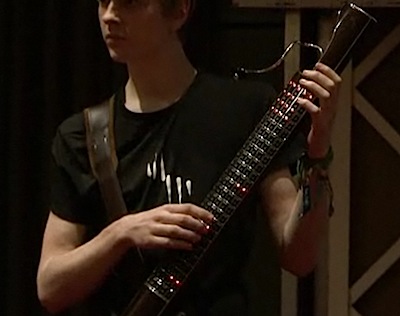
The Eigenharp is a new electronic performance instrument designed to maximize expressive control of modern virtual software instruments. It has 120 keys arranged in a 5x24 grid, each of which can register 2048 levels of pressure in 3 dimensions. This means you could play a chord with your left hand, and use each finger to simultaneously alter the pitch, volume, and expression of each note of the chord (or any other parameters of your choice). That leaves your other hand free to play a drum rhythm on the 12 additional percussion keys, or to use another part of the keyboard as a programmable looping pattern sequencer. There's also a mouthpiece for breath control, two ribbon expression controllers on the sides, LED indicators on each key, etc. Check out the video of the product launch at Sonic State, or learn more at Eigenlabs' website.
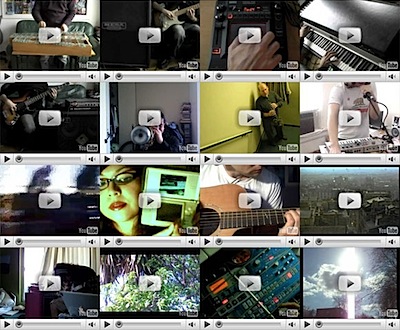
In the YouTube mash-up spirit of Kutiman, a project called In Bb presents you with a grid of unrelated YouTube videos that all happen to be in the key of B-flat. There is no percussion or meter, so things will always blend together smoothly no matter when you start or stop each video. Try to resist the urge to play them all at once - turn on a couple at a time, then add new ones as time goes on. The effect is incredibly beautiful.
Farmers in Nuanquan, China, too poor to afford fireworks to celebrate the new year, instead melt down scrap metal and hurl it against a wall, creating a brilliant spray of sparks and molten iron. Their only protection is a sheepskin coat and a hat. [video]

There's a new show on the Discovery Channel called "Time Warp" - it features extreme slow-motion footage of events that happen very fast, such as what happens when you put a lighter in a blender:
French composer Pierre Bastien builds small mechanical musical devices, which click and whirr and play somber melodies on keyboards as he follows along on his muted trumpet, occasionally reaching over to adjust a lever or attach a new part. It's an intimate and introspective affair.
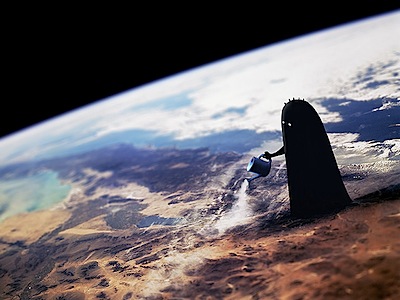
Dmitry Maksimov works in a variety of styles and media, but I'm most fascinated by his photo illustrations that show small characters going about their mysterious business in realistic settings with narrow depth-of-field. It's a fleeting glimpse into a cute and spooky world. Visit the artist's site (it's in Russian, but just scroll down for the images).
"In 1969, a 14-year-old Beatle fanatic named Jerry Levitan, armed with a reel-to-reel tape deck, snuck into John Lennon's hotel room in Toronto and convinced John to do an interview about peace. 38 years later, Jerry has produced a film about it. Using the original interview recording as the soundtrack, director Josh Raskin has woven a visual narrative which tenderly romances Lennon's every word in a cascading flood of multipronged animation. Raskin marries the terrifyingly genius pen work of James Braithwaite with masterful digital illustration by Alex Kurina, resulting in a spell-binding vessel for Lennon's boundless wit, and timeless message." Watch on YouTube
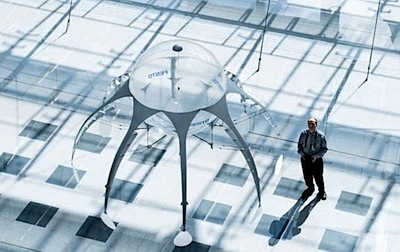
Researchers at automation technology company Festo have developed what just might be the Best Robot Ever. They've made a version that swims in the air using helium and lightweight tentacles, as well as one that swims underwater. Totally mesmerizing - check out the video!
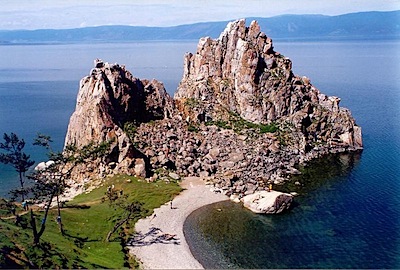
Best. Lake. Ever. Lake Baikal, in southern Siberia in Russia, contains over 20% of the world's fresh water and is home to over 1700 species of plants and animals, of which two thirds are found nowhere else. Although less than half the surface area of Lake Superior, it's over a mile deep, comprised of an ancient rift valley where the Earth's crust is pulling apart at two centimeters per year. As the rift has expanded over the millenia, it has filled in with a layer of sediment that is now four miles deep.
Due to its extreme age (25-30 million years) and isolation from other bodies of water, Lake Baikal has developed many unique species that are unlike any found elsewhere, and is therefore often called the "Galapagos of Russia". The lake is home to a species of freshwater seal, as well as the translucent Baikal oil fish, known for liquefying into a slurry of oil and bones when dredged up from the extreme pressures at the depths of the lake.
In the late 1990s, artists Vitaly Komar and Alex Melamid, along with composer David Soldier, polled 500 music listeners to determine the least desirable musical qualities. They compiled their data and then composed a piece of music that incorporated as many of these qualities as possible, titling the final product "The Most Unwanted Song". The folks polled apparently don't like rap music, sopranos, or songs about cowboys, so their song prominently features a soprano rapping about cowboys. Other features include tubas, banjos, accordions, sudden changes in dynamics and tempo, children's choirs singing about holidays (Labor Day, Ramadan) and corporations (Wal Mart, Coca Cola), and an uncomfortable length of 25 minutes.
The end result, in my opinion, is catchy and fascinating - much more than the sum of its unwanted parts. If you've ever enjoyed Mr. Bungle, I think you'll love this song. You can stream it from the Wired article, or download the MP3.

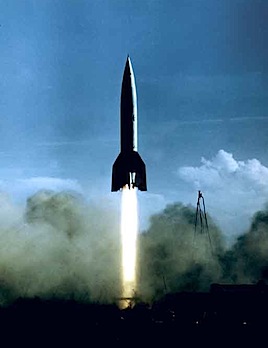
The V-2 rocket, produced by Nazi Germany during World War II, was the first man-made object to achieve suborbital spaceflight and was the precursor to all modern rockets, including those used for human spaceflight. Germany launched over 3,000 of them at Allied countries up through 1945, claiming 7,000 military and civilian lives, mostly in London and Antwerp, as well the 25,000 slave laborers who died while being forced to produce them.
The 46-foot-long rocket's liquid oxygen-fueled engine would burn for only about 65 seconds before cutting off, using two gyroscopes and a simple analog computer to determine the exact angle of the rocket at the moment the engine cut off. The rocket then followed a purely ballistic trajectory the rest of the way to its destination, sometimes landing within meters of its target. The V-2 had a range of up to 200 miles at an altitude of 55 miles.
Whenever the rockets fell in London, there would be no warning before the explosion, as the V-2 traveled at supersonic speeds. Just after the explosion, a characteristic fading whistling sound could often be heard. In fact, the British government denied that the city was under rocket attack until it had been going on for weeks, instead attributing the explosions to other causes.
When Germany fell to the Allied troops in 1945, the V-2's creator, Wernher von Braun, and his whole team surrendered to the Americans in order to prevent their technology from going to the Russians. Von Braun went on to create the rockets first used by the fledgling US space program, including the giant Saturn V rocket that took astronauts to the moon.
D. B. Cooper was the alias of a man who hijacked a Boeing 727 in 1972 and then disappeared after parachuting out of the plane. The dapper man in a crisp suit passed a note to a flight attendant claiming he had a bomb in his suitcase. He demanded $200,000 in unmarked $20 bills, and four parachutes. After the plane landed and officials met his demands, he released the passengers and told the crew to take the plane back into the air. Then, somewhere over the Pacific Northwest, he opened the rear stairway of the plane and, strapped into a parachute and clutching the briefcase full of cash, leapt into a furious rainstorm, never to be seen again. It is unknown if he survived the jump, but in 1980 about $5000 of the bills he had been given by the FBI were found in the mud on the banks of the Columbia river. It is not known if they were buried or just washed up there.

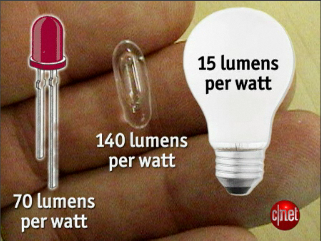
Silicon Valley company Luxim has created the most efficient light source yet, at 140 lumens (units of light output) per watt. For comparison, today's most efficient LEDs only produce 70 lumens per watt, and a normal incandescent bulb produces a measly 15. They have produced a bulb the size of a Tic Tac that produces as much light as a street lamp using a fraction of the power. They use an electrical charge tightly focused into a small capsule of argon gas. The argon turns into a 6000 degree plasma, as hot as the surface of the sun - which is the reason why the light it emits has the same spectrum as natural sunlight. Check out the CNET video to see it in action.
So Bruce is the lead singer for this heavy metal band called Iron Maiden, which was pretty big in the 80's but is still rocking out today. As if being the lead singer for Iron Maiden wasn't awesome enough, Bruce was also really into fencing and competed internationally, and started his own fencing equipment company. And as if being the lead singer of Iron Maiden and being a top international fencer wasn't awesome enough, Bruce also decided to become an airline pilot and now flies Boeing 757 jets for a UK charter airline. Then, in a final coup de awesome, he had a 757 painted with the Iron Maiden logo, climbed into the pilot's seat, and flew his band on their world tour. Bruce Dickinson, you're awesome.

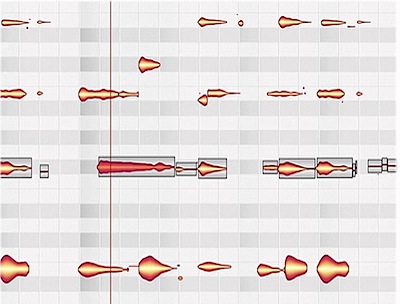
Music software company Celemony has announced the latest version of their pitch correction software, Melodyne. While it's been possible for quite some time to use software to correct or change an individual note in a recorded melody, until now it's only been able to do that with a monophonic melody, meaning only one note is playing at a time, such as a voice or a flute. The breakthrough is that they've finally made it possible to actually access all of the notes in a polyphonic recording, such as a strumming guitar or a chorus of voices. The software extracts each note and displays it in a grid, where time goes from left to right and pitch goes from bottom to top. You can then select each individual note with your mouse and move it up or down in pitch, forward or backwards in time, adjust it louder or quieter in volume. You can use this as a tool to make subtle corrections, or create a whole new piece with the same instrument. Check out the video to see it in action (and forgive the poor voiceover announcer for not knowing how to pronounce "monophonic" or "MIDI").